Abstract
Over the last 10 years the concrete and steel utility poles has become a serious threat to the wooden pole in Africa. This is due to the early wooden pole failures due to a lack of specifications, standards, and third-party inspections in most African countries.
Eskom South Africa, being one of the largest electrical utility companies in Africa is currently one of the utility companies who have controlled the quality of wooden poles supplied. Eskom has a wood pole population of over 6 million poles and the average lifespan of the lines is around 35 years.
Eskom continues to use wooden poles for MV lines for the following reasons:
- the price of wooden poles
- the availability of wood for poles in South Africa
- the effective drying and treatment processes in place
- the ease of erection of wooden poles structures
- Climb ability of wooden poles
Eskom have included gatekeepers and controls in the purchasing of wooden poles to ensure poor quality poles are not brought into their system. They only purchase wooden poles from approved suppliers who comply to their strict quality management system requirements.
Life cycle costs of utility poles.
The biggest threat to the survival of the wooden pole is poor quality. Wooden poles need to last 35 – 40 years to be cost effective (life cycle costs). The wooden pole industry needs to work together to ensure that the life cycle costs are lower than the steel and concrete poles.
Pole failures in Africa are a threat to the wooden pole industry What have we learnt in Nigeria?
NEMSA to Outlaw Use of Wooden Poles in Nigeria’s Electricity Sector
Abuja — The Nigerian Electricity Management Services Authority (NEMSA), a technical inspectorate set up by the federal government to enforce technical standards in Nigeria’s electricity industry, disclosed that the use of wooden poles to supply electricity in the country would no longer be accepted.
What have we learnt in Kenya?
Shift to concrete electricity poles hurts wood suppliers. KENYA
A shift to concrete poles by Kenya Power and the Rural Electricity Authority (REA) has triggered disquiet among suppliers of wooden materials with a section of players accusing the two State agencies of bias. The two agencies – citing lower maintenance costs – have switched to concrete poles, locking out wooden material suppliers from their tenders.
Eskom address wooden pole failures in 2000.
Coupled with various failures of wooden poles from the 1990’s Eskom changed their Eskom specification NWS 1511 to DSP 34 1647 rev 2. The specification has since been regularly updated by Eskom.
Eskom went out and researched the reasons for early pole failures in 2000 to determine the root cause of the wooden pole failures.
The following major changes were brought into the Eskom specification.
- 2004 the kiln drying
- 2005 the ISO 9001 QMS
- 2006 the retention requirements were changed to ensure the treaters treated to
The pole maintenance program also was developed from 2000 to 2011 by:
- firstly, drawing up a national inspection standard for the maintenance of wooden poles based on various
- developing , testing and approval of stubbing methods to be used on poles that could be
- implementing a suitable woodpole maintenance cycle from various costing models
- implementing a 100% maintenance program over 10 years on each pole to identify the state of each
- identifying suitable products that would prolong the serviceability of the wooden pole, this included looking at models from other countries.
- testing of these products identified ensuring they will support our 10-year maintenance
- embarking on a national maintenance program to inspect and apply the approved chemicals to each serviceable pole to ensure that that the pole life will be extended.
- developing a national data base for the inspected
Use of Wooden poles in Eskom
Currently around 70% of the poles in service are eucalyptus poles and 30% pine poles. All new poles used by Eskom are currently eucalyptus due to the shortage of suitable pine poles in South Africa.
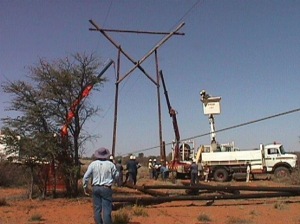
Replacing a 5 pole wooden structure in the Kalahari Region of South Africa.
Advantages of Wooden poles
Presently the following is the advantages of using wooden poles for lines in SA.
- Price: as all our wooden poles are grown commercially in South Africa the price is very competitive compared to steel and
- Weight: The weight of wooden pole is very favourable compared to concrete and hence construction is made
- Ease if Construction: Because wooden poles are drillable on site, the correct configuration and phase spacing can be drilled on site.
- Climbable: Wooden poles that are creosote treated are climbable, not so with concrete and
- Renewable Resource: all wooden poles used in South Africa are commercially grown and are
- Longevity: when wooden poles are dried correctly, treated properly and maintained with a proper cycle and treatment chemical they will last many decades and hence replacement cost are greatly reduced.
- Withstands bush fires: Wooden poles treated with creosote withstand most bush fires which might occur in the dry
Critical factors of wooden poles to reduce lifecycle costs.
There are a number of critical factors in the design, supply and handling of wooden poles that need to be addressed in order for the wooden pole to last 40 years and justify the life cycle costs.
- Line design to reduce costs of grid extensions
- Utilities own specification with gatekeepers to ensure strength and quality of treatment of
- Strength requirements of each
- Drying requirements before
- Treatment plant requirements – retention and
- Type of
- Role of third party
- Transport and handling of
- Pole maintenance
Challenges using Wooden pole.
Raw material (specie of timber) not suitable for transmission poles
The specified raw material needs to be monitored and ensured that only timber that can maintain the required life span and strength be used.
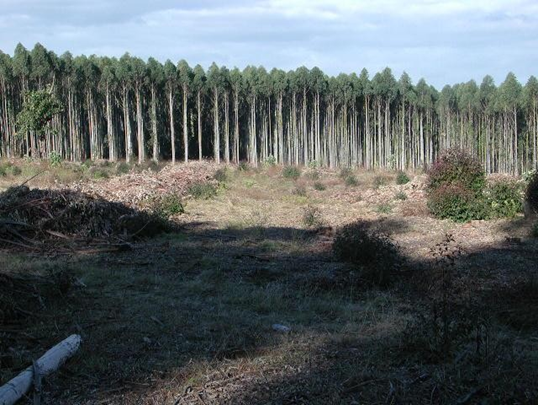
A typical forest being harvested.
Poor drying methods
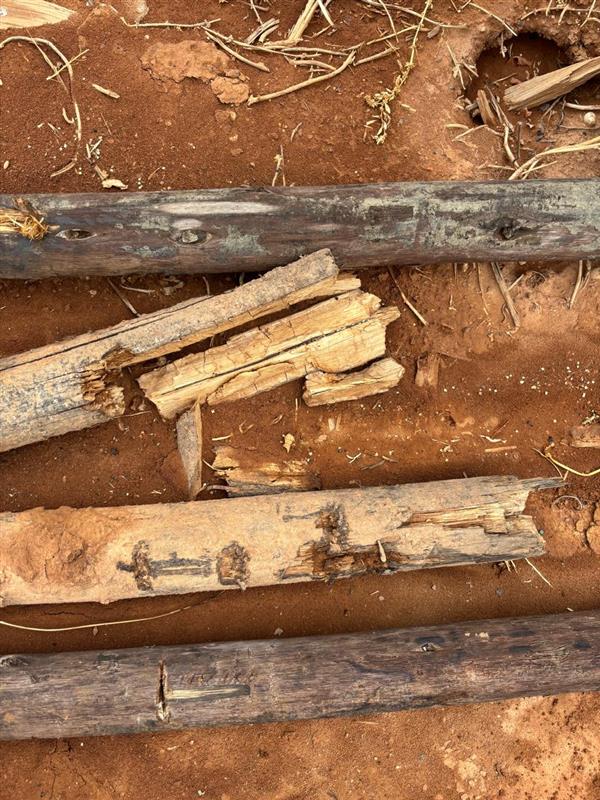
When an air dried pole is not dried correctly and then treated, there is a greater probably that it will crack and then leave untreated wood exposed which is then susceptible to fungal spores and termite attack.
Poor Treatment
The pole that is treated needs to be treated at the correct moisture content to ensure that the correct penetration and retention of the creosote is attained. If the wooden pole ‘s moisture content is above the fibre saturation point the water will prevent the creosote from entering the pole and hence premature failure can occur.
Poor Quality Control.
- Quality Control
The treating plant shall appoint an employee, trained in quality control procedures, who shall be designated as plant quality control supervisor and who will be responsible for conformance of treated products to the standards and specifications and for the accuracy of equipment used to monitor the treating processes.
- Plant Equipment Calibration of gauges.
Monitoring of equipment to ensure proper operating condition.
- Wood Moisture Content
Products before treatment must meet moisture content requirements.
- Record Keeping
Records must be kept for each processed lot or charge showing the purchaser, an identification number, date treated, material description and volume expressed in cubic feet and solution concentration. Records shall also be kept to show compliance with requirement for penetration, and for retention as measured by either gauge or assay in accordance with the applicable customer specification. All records shall become a part of the treating company’s permanent file.
- Sampling for Penetration and Retention
Treating plants shall perform sampling and inspection of all treated products.
Preservative Plant Quality Control shall determine that the preservative used in each treatment conforms to the requirements for the preservative specified.
- Plant Gauges:
Pressure plants shall be equipped with recording instruments to register time, pressure, temperature and vacuum during each cycle of treatment. Pressure, temperature and vacuum shall be recorded in the common units of kPa (psi), °C (°F), and inches of mercury respectively. Treating equipment shall have separate and visible temperature, pressure and vacuum indicators with separate sensors for checking the accuracy of the recording equipment. Work tanks shall be equipped with a temperature indicator. Treating cylinders shall be equipped with a time and temperature recorder and with an indicating thermometer. Where heat is not required for proper treatment of the material and no facilities exist for application of heat to the treating vessel, working and/or storage tank, the temperature devices are not required.
Important processes in the treatment of poles
Drying of poles
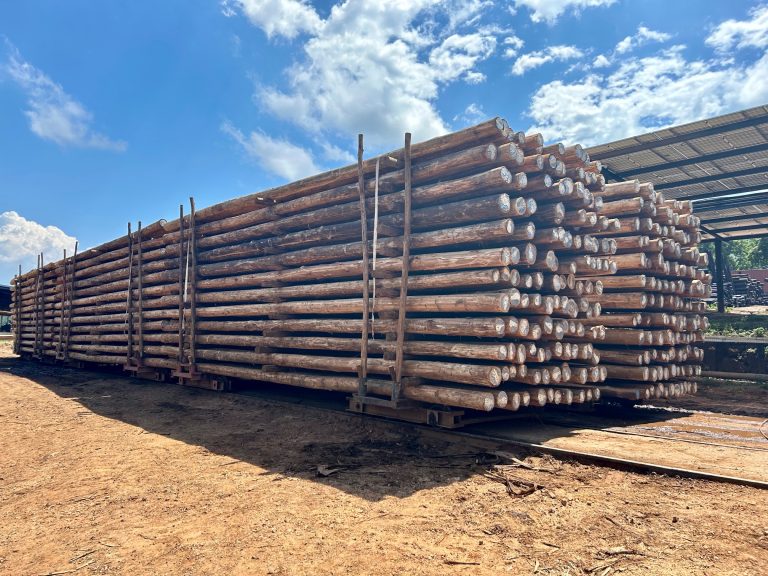
Kiln drying is the process where poles are dried using high humidity and heat in an enclosed environment.
Advantages of kiln dried poles
- Poles are made available for treating within 10 days of the drying process
- Poles are sterilised during the kiln drying process as dry bulb temperatures reach 800 C hence all fungal spores and insects are killed.
- Internal stresses are released during the drying
- From felling of the tree to treatment can be as little as 2 months, hence small lead times are
- There is no loss of strength at the end of the drying
Eskom only accepts kiln dried poles for poles longer than 7m in length.
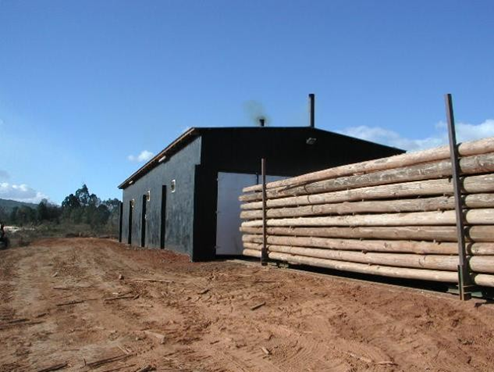
Poles ready to go into the kiln.
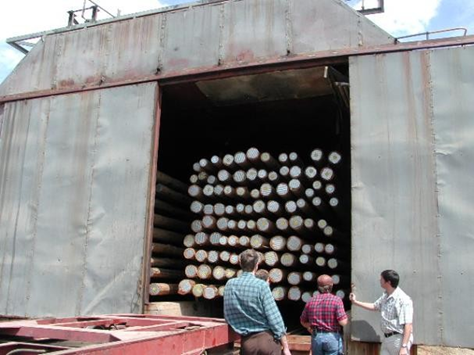
Poles paced in a kiln ready for drying.
Treating of poles.
Eskom has found that creosote treated poles are cost effective on life cycle costing if the specie, drying methods and treatment methods are controlled and if a woodpole maintenance program is maintained. By applying a properly tested re-treatment chemical to the planted pole to prevent fungal attack in the pole, the pole can attain a life of 40 years plus.
Creosote is an excellent primary treatment for the prevention of fungal spores in the treatable zone of the wood. Creosote as a preservative is an excellent barrier for termites where termites are a problem in an area.
Creosote treated wooden pole ensure that the wooden pole is climbable with climbing irons once erected. Creosote is bio degradable after a period of time.
Pressure tank
For this method of treatment the dried wooden poles are placed on trolleys and driven into the pressure vessel. The pressure vessel door is then shut and the creosote is then pumped into the pressure vessel until the correct retention of creosote is attained. When completed a vacuum is applied to the pressure vessel to remove all free creosote and hence have a relatively dry treated pole..
Retention and penetrations
The treatment, shall conform to the customer specification for the commodity and type of treatment specified. Plant Quality Control shall maintain records on the cycles of treatment and the tank gauge readings and temperatures.
Careful observation during treatment shall be made of temperatures and pressures, and their duration, to make certain that maximum limits are not exceeded. The charge shall comply to the retention and penetration requirements of the customers specifications.
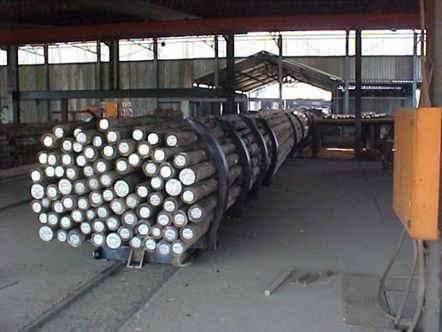
Poles loaded onto the trolley ready to go into the pressure vessel,.
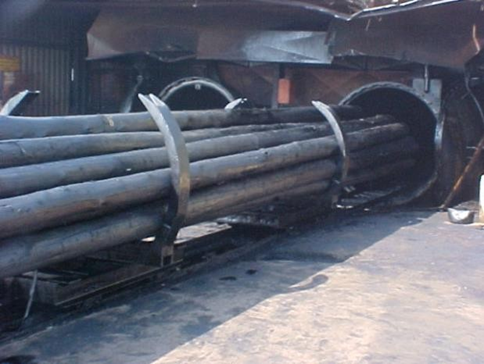
Poles coming out of the pressure vessel having been treated.
TYPES OF PRESEVATIVES.
The customer needs to determine which the best suitable preservative based on availability of the preservative and the specific area where the wooden pole will be in use.
Currently in Africa the customer has an option of the following.
- Creosote
- CCA
- Copper azole compounds (CuAz).
- Alkaline-copperquaternary compounds (ACQ).
The selection of what type of treated wood pole to use in a particular utility system is an issue of paramount attention and deliberation. While the relative percentage of each of the above preservatives used in utility treated wood transmission and distribution structures varies, each preservative plays a unique and critical role in the overall ability of utilities to provide reliable and cost-effective electrical service to the public.
Each preservative has unique characteristics that are evaluated by utilities in determining which preservative is best suited for use in a particular region of the country. These decisions are based on a variety of factors, including the physical and performance characteristics of the preservative, the location of the service area, and the associated environmental, climatic and developmental (urban versus rural) characteristics of the service area. In circumstances where one preservative may serve as effectively as another in any particular setting (e.g., the use of creosote-treated wood poles in hot, dry climates), other variables such as costs, supply and worker acceptability (e.g., utility linemen may prefer working with one treated wood pole over another) are important factors in selecting the type of treated wood used in a particular setting.
In short, there is not a one-to-one “substitutability” between the above preservatives; rather, each preservative is selected for use by utilities depending on a variety of unique preservative characteristics and the individual needs of each utility.
Currently in Africa the customers are predominantly using creosote or CCA for electrical and communication lines.
CCA.
Although CCA also has an excellent track record regarding its performance as a heavy duty wood preservative, it is a water-based
formulation as opposed to the “oil”-based creosote and therefore does not afford any water repellency or “lubricating” properties to the treated timber. Surface checking and end splitting of CCA-treated Eucalyptus poles as a result of drying stresses are therefore experienced, especially when poles are stored and used under hot, dry conditions soon after treatment. The treated poles should either be properly conditioned and/or dried after treatment to the prevailing relative humidity and resultant wood moisture content before being used in order to avoid any unacceptable surface checking and end splitting.
Drying stresses in poles are caused by moisture differentials, also known as the moisture gradient between the outer layers and the inner core of a wooden pole. When the inner core of the pole is still in a swollen state as a result of high moisture levels and the
outer layers start to dry out and shrink, high stress levels occur on the outside of the pole causing the wood fibres to separate and form surface checks that may extend deep into the pole. Rapid loss of moisture from the end grain of poles is further responsible for very high drying stresses to develop in these areas, resulting in end splitting during storage. It is therefore important reduce these moisture differentials between the outer layers and the inner core of a wooden pole as well as at the pole ends to a minimum, especially after treatment with water-borne wood preservatives. This can be done by either controlled drying/conditioning or application of a water repellent post treatment that retards moisture loss after pressure impregnation with water-borne wood preservatives.
Many end users such as farmers using fencing and vineyard poles and also electricity supply companies utilizing large quantities of wooden utility poles prefer creosote as a preservative treatment because of its oily nature. Not only is creosote resistant to fires but it also provide a great deal of water repellency to the treated timber at the same time it “lubricates” the wood. This ensures that creosote-treated poles, especially those obtained from Eucalyptus species, resist surface checking and end splitting to a large extent when exposed to conditions that cause drying stresses in the timber.
CCA – Circumstances Where the Use of CCA-Treated Poles Is Specified Over the Use of Creosote-Treated Wood Poles
CCA-treated poles are specified for locations where a dry, residue-free surface is required (United States Department of Agriculture, Forest Service (USDA), and/or odours are not acceptable, including, for example, in urban areas where sidewalks are common and poles are set through the sidewalk into the ground. In this setting, CCA-treated poles are frequently specified as the best choice because creosote-treated poles sometimes “bleed.” Bleeding causes oily staining at the base of a pole. Use of CCA is also specified frequently for residential areas, where contact with the wood surface is more likely than in rural areas and where staining/odours may be a concern.
In areas with high soil moisture, where the water table is high, or water is perched at a shallow depth, CCA-treated poles are specified over creosote-treated poles because the CCA preservatives are “fixed,” or chemically bonded within the wood. Proper fixation minimizes the risk of leaching. Long-term subsurface saturation is less likely to deplete the CCA preservatives, shortening service life, and increasing the risk of early pole failure and unplanned electrical outages.
CCA-treated poles are also specified in areas that experience occasional freshwater flooding, because the CCA is fixed and thus helps ensure a longer service life. Further, in these “flooding” environments, creosote poles may cause an unacceptable sheen in the water.
Creosote.
Creosote – Circumstances Where the Use of Creosote-Treated Poles Is Specified Over the Use of Penta- or CCA-Treated Wood Poles
From an operational and functional perspective, one of the highest-valued uses of creosote-treated wood poles is along coastal areas. Creosote -treated poles also repel salt water better than CCA. Use of creosote-treated poles in this environment ensures the reliable and cost-effective delivery of electricity to the public.
From an operational perspective, creosote-treated wood poles are also specified for use by utilities in hot and dry environments. Creosote is a better choices as preservatives in these environments over CCA because the carrier oils keep the wood “lubricated” and “soft.” As such, there is less splitting/cracking/checking than typically occurs with CCA poles in this environment.
Creosote-treated poles may have greater flex (due to the “oil” content) than CCA-treated poles, which are dry and stiffer. Creosote may be specified in areas prone to impact loads such as ice and/or wind.
In coastal settings, where poles may experience occasional flooding, creosote poles are more effective at preventing marine borer damage.
ROLE OF THIRD-PARTY CERTIFICATION.
The inspection of a batch of poles is not sufficient. It is important for the customers and the industry that all poles supplied are through a certification mark scheme.
Key benefits of third-party certification body.
- Ensure the quality and quantity of the
- Ensure the marking and product as per buyer
- Ensure the material is genuine and as per specified
A certification body is a third party and an independent inspection agency which provides facilities in the different type of field without discriminatory decisions. In the wooden pole market in Africa third party inspections can play a very important role in ensuring the wooden pole remains the preferred transmission and telecoms utility pole over the concrete and steel poles.
Improved product quality
One of the most important benefits of third-party inspection for suppliers is the quality improvement that often results. Sometimes inspection reveals a product defect that’s easily preventable. Regardless of whether the defect is major, minor, or critical, knowing about it before shipping helps the supplier address the root cause to correct the underlying problem.
What is a product certification scheme?
As products are designed, produced, distributed, used and ultimately disposed of, they can give rise to concerns with purchasers, users and society in general. Such concerns could relate to safety, health or environmental impacts, durability, compatibility, suitability for intended purposes or for stated conditions.
Generally, these concerns are addressed by specifying the required product attributes in a normative document such as a standard. The supplier of the product then has the task of demonstrating that the product conforms to the requirements of the normative document. It might be sufficient for the supplier to assess and declare its product’s conformity, but in other cases the user or a regulatory authority might require that conformity be assessed by a competent and impartial third party.
Assessment and impartial third party attestation that fulfilment of specified requirements has been demonstrated for the product is referred to as product certification.
Conformity assessment is done by an accredited Certification Body which acts in the interests of a fair deal between the first and second parties. The Certification Body acts as a third party between producers and end-users or between government and suppliers.
How does a third party become a certified mark scheme?
Certification is part of conformity assessment, the process whereby an independent neutral body confirms that a product or service complies with any national standard.
Not any organisation is declared an independent third-party conformity assessment provider. First, it must be declared competent to provide the service: it must be accredited. In South Africa, accreditation is provided by the South African National Accreditation System (SANAS).
SANAS is one of 3 bodies in Africa responsible for carrying out accreditations in respect of conformity assessment. These includes accreditation of-
- calibration, testing and verification laboratories;
- certification bodies;
- inspection bodies;
- rating
This accreditation confirms that the Certification Body is technically competent to fulfill its function, that its results are impartial and that it can be trusted by all parties.
The Certification Body, however, also acts as a third party between e.g., South African manufacturers and East African end-users or between East African manufacturers and South African customers.
This phrase “Certification Body approved” refers only to products which have attained the Certification scheme mark, a product certification scheme offered by the Certification Body. A product is certified when it has been assessed by an independent third party to the requirements of a specification such as a national standard. The product is then certified if it meets the specifications.
To attain the Certification Body Mark Scheme, the product must meet the specifications of the national standard applicable to it. The Certification Body will also inspect the product manufacturer’s production facility to determine whether it has adequate quality assurance systems in place (e.g., ISO 9001) to ensure continued and consistent quality. The Certification Body will then conduct
ongoing audits of the quality management system, as well as regular tests of product samples (obtained from both market outlets or from the factory) to verify that the product still meets the required national standards or specifications.
National Specifications and Standards
All specifications and standards in any country need to address the following criteria in order for poles to last 40 years. Below is a comparison of Eskom standards and the rest of Africa.
Critical factors to ensure wooden poles last 40 years plus. | ESKOM | AFRICA |
National specification Updated Private specification in use | YES NO | NO NO |
Strength requirements updated | YES | NO |
Drying gatekeepers 1. Drying schedule determined and recorded
2. Moisture test method sufficient for kiln dried timber at end of drying. 3. Control over air dried timber and reduction of heartwood moistures | YES YES YES YES | NO NO NO NO |
Treatment gatekeepers 1. Treatment process insures treatment to refusal for all poles | YES NO | NO NO |
Retention requirement to check if actual retention is achieved in different batches. | NO | NO |
Third party inspections available. Third party inspection of chemical suppliers Third party inspections in customer depots | YES YES YES | NO NO NO |
Pole Maintenance Program up to date | YES | NO |
History of South African creosote poles in Africa.
South African treatment plants have been supplying creosote eucalyptus poles to Southern and Eastern Africa since 1990.
The creosote poles supplied are still standing and last three times longer than the poles supplied locally. This can be attributed to the quality of the preservative (creosote) and treatment standards of the South African treaters. SAUPA are looking for opportunities to promote this positive information in order to promote the use of South African poles.
The poles purchased locally by the East African countries are slightly cheaper than the delivered price from South Africa but they don’t have the lifespan of the South African poles.